The royal chronicles
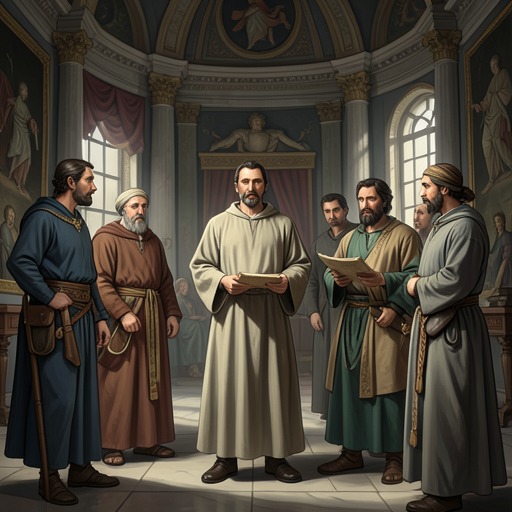
Book of EstherThe royal chronicles are the Persian Empire’s records of past events, but in the Book of Esther their decisive importance lies in one entry: the account of Mordecai exposing a plot against Ahasuerus. Years—or at least a substantial interval—after that service went unrewarded, the record is read to the king on a night when he cannot sleep. Its discovery brings Mordecai’s forgotten loyalty back to the royal court at the moment Haman is approaching to demand his life. The chronicles thus become more than an archive: they are the means by which an unrecognized deed returns to change the immediate course of events.
The Record and the Forgotten Service
Mordecai’s entry recalls that he had reported a conspiracy by Bigthana and Teresh, two of the king’s chamberlains who guarded the door and sought to lay hands on Ahasuerus. His warning had been entered into the official record, but no honor or dignity had followed. The chronicles preserve the fact of his service without themselves securing its recognition; the account can remain in the archive while the person who earned the reward remains exposed and unrewarded.
That separation between written memory and public acknowledgment gives the entry its force. Mordecai’s service is not newly performed or newly discovered in the larger history; what changes is that the king hears it and asks what recompense was made. His attendants answer that nothing was done for him. The record makes the omission visible to the monarch and converts a past act into an urgent present claim.
The Sleepless Night
The chronicles enter the action when Ahasuerus cannot sleep and orders that the book of records be brought and read before him. The narrative emphasizes the conjunction of ordinary choices: the king’s wakefulness, his decision to hear the chronicles, and the reader’s arrival at the passage about Mordecai. The book does not specify a supernatural interruption of nature. Instead, a routine consultation of the royal archive brings the neglected report before the king at the critical hour.
The timing is sharpened by Haman’s presence at court. He has come intending to ask the king for Mordecai’s life, while the king has just learned that Mordecai once saved his own. The chronicles do not themselves describe Haman’s later humiliation or Mordecai’s promotion, but their entry sets the reversal in motion: a question about an unpaid reward is raised before Haman can make his request.
An Archive Made Pivotal
The book’s providential interpretation rests partly on the narrowness of the chain. In the author’s account, the chronicles might have been read without reaching the relevant lines; the vast annals of the Persian Empire offered many other possible subjects. Yet the reader comes to the record of Mordecai’s service, and that precise recovery matters because a further delay could have left him in the hands of his enemy. The archive’s ordinary function—preserving past events—becomes consequential through the particular moment at which one entry is recalled.
The author treats the king’s sleeplessness and the choice of reading material as genuine actions of the king, while also understanding them as instruments of God’s purpose. The chronicles therefore stand at the intersection of human agency and providential interpretation: they record an event, but their delayed reading gives that event new force. Their role exemplifies the book’s larger argument that deliverance can unfold through a connected sequence of natural, seemingly incidental circumstances rather than through a miracle.
Narrative Significance
The royal chronicles make memory an active part of the plot. Mordecai’s earlier deed has not disappeared; it has been preserved in writing, though its significance remains dormant until the king hears it. At the turning point, the written account supplies the grounds for the king’s question, and the answer that no reward was given exposes an omission that can no longer remain merely archival.
The episode also contributes to the Book of Esther’s design as a history in which small details acquire consequence through their place in a larger sequence. The author presents the chronicles as one link among events that bring the Jews from danger toward deliverance. In that reading, the record’s importance is not that it announces the future, but that it keeps a past act available until the moment when its recovery can alter what is about to happen.